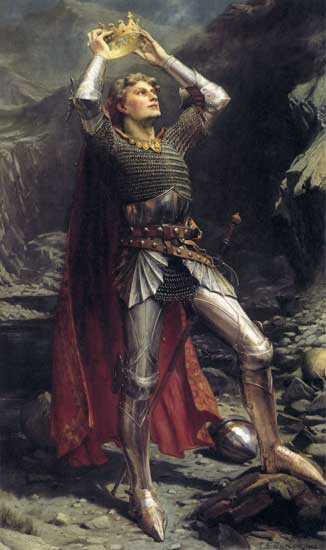
Arthur is one weird character, but after being around for such a LOOOOOOOONG time, he really can’t help it.
King Arthur is the centerpiece of the Arthurian legend. The only things we can agree on is that he’s a) King of Camelot b)Married to Guinevere c)Wielder of Excalibur and d) He dies by the hands of some guy named Mordred. So what do we actually know about the character for sure?
Arthur is simultaneously a king of unquestionable morals and power, and the guy who had sex with his sister and ordered the murder of every baby born in May to cover up said sexcapade.
He’s a shining example of chivalry and aristocratic ideals and also a vicious warrior who single-handedly halted the saxon invasion in 500 AD. Arthur is the product of an ancient Celtic myth of a hero king and the Christian movement of later centuries.
Arthur is everyone and nobody all at once and that’s what makes him so fascinating.
Arthur, the historic figure who created the “brief-shining-moment-that-was-Camelot” part of the legend was some random guy who, as I mentioned above, stopped the Saxons from totally taking over Britain and wiping out the native population. We don’t know who he was, but we know he was super-cool and without him the English language would have probably died back in the 6th century. The Welsh named him Emrys Wledig, but he can also be called Ambrosius Aurelianus or the Transformer-sounding-name of Riothamus/Rigotamus
Arthur the mythical hero, stretches back a little further. He most likely stems from an ancient story about a warrior king who had the ability to turn into a bear. At the very least, he was explicitly talked about in the ancient Welsh legend of Culhwhch and Olwen (please don’t make me say her name out loud), where he helps his cousin Olwen win the hand of the fair Culhwch.
At some point in history, people decided to marry these two and BOOM! King Arthur was born.
Arthurian myth has changed throughout the years to fit what the world wants to hear at the time.
When reading Le Morte d’Arthur for example, the emphasis is placed on the bygone glory of chivalry and knighthood, as told from a knight who was hungry for that glory. If you read The Once and Future King, we’re reminded that this version of the story was told by a man living in the shadow of WWII, with all of its violence and dangerous thoughts.
Arthur is no exception to this rule. He has changed to suit what people viewed as an ideal king. As the King became less of a symbol of protection and became seen as a useless and often corrupt figurehead, Arthur did the same. The powerful guardian of his people was re-imagined and de-fanged into progressively impotent incarnations until his character was limited to being the poor, clueless schmuck Guinevere was being unfaithful to. Quite a change from a guy who could turn into a bear at will!
There was little fuss made about Arthur’s order to kill all the noble children born in May when it was first introduced to the legends. The fact that he slept with his older sister was still bad, but wasn’t a reason cause a ruckus. As time went on and morals changed, the softer incarnations of Arthur had to deal with these really bad choices made by a ruthless Arthur from a tougher time. When writers tried to grapple with incest and child-murder of early legends, Arthur’s character took a beating. Usually, they just ignored the two events and tried to pretend it never happened.
One of Arthur’s most obvious turning points was when Lancelot was introduced in the 13th century. Arthur hadn’t changed much in the seven centuries from the saxon invasion till then, but he HAD to be re-vamped in order for Lancelot to work. No ancient Celtic hero worth his salt would lay down and accept some random French guy strolling into his house and seducing his wife. Lancelot would have been viciously disemboweled and had his head on Arthur’s wall before he could so much as wink at Guinevere.
Enter Arthur 2.0, a slightly more kid-friendly version of the bear king that the Lancelot could work around. As Lancelot became more powerful, he rose to a level of god-like mary-sue that he could take on the old Arthur, but he would have never made it to puberty if the French writers hadn’t given Arthur a little tweaking.
In modern times, there is no telling what flavor of Arthur you’ll get. NOTHING is OOC anymore!
With the advent of the internet and easy-access information, the world is a little more aware of King Arthur’s many versions. You can have any combination of the Arthurs that have existed throughout the centuries and any number of new spins that are just as valid. (I think we’re all aware of the gender-bent anime version by now, and yes, that is a valid take on King Arthur).
In conclusion: Arthur is bi-polar because he’s the literal incarnation of kingship in the western world, which has changed in the 1500 plus years he’s existed.


